

Competitive gaming didn’t begin in packed arenas or million-dollar prize pools—it started in dimly lit arcades where high scores meant everything. To truly understand today’s global esports phenomenon, you need to trace the evolution of esports tournaments from grassroots showdowns to professionally organized, stadium-filling spectacles. This article delivers a clear, chronological breakdown of the milestones, technological breakthroughs, and game design innovations that shaped competitive gaming into a multi-billion dollar industry. Drawing on deep analysis of gaming mechanics and industry trends, we connect the early arcade rivalries to the complex, high-stakes tournaments that define modern esports.
The Genesis: High Scores and LAN Parties (1970s–1990s)
Competitive gaming didn’t start in packed arenas—it began in university labs. In 1972, Stanford hosted the “Intergalactic Spacewar Olympics,” widely recognized as the first organized video game tournament. Players competed in Spacewar! for a year’s subscription to Rolling Stone. It sounds quirky (and it was), but it marked the first time digital skill became a public contest.
The concept grew in 1980 when Atari’s Space Invaders Championship drew over 10,000 participants across the U.S. For clarity, a tournament simply means a structured competition with rules and rankings. This event proved gaming could attract mass audiences and corporate backing—an early hint at the evolution of esports tournaments.
During the 1980s, Twin Galaxies began tracking arcade high scores. A high score is the highest recorded point total in a game, often achieved solo. By verifying records, Twin Galaxies created the first recognizable “pro” gamers and fueled rivalries (think King of Kong-level drama).
Then came the 1990s LAN revolution. A LAN party—short for Local Area Network—connected computers in one physical space for multiplayer matches. Games like Doom and Quake shifted competition from chasing numbers to direct, head-to-head combat. That shift laid the technical and cultural groundwork for modern esports.
The Internet Era: Forging a Global Scene (Late 1990s – 2000s)
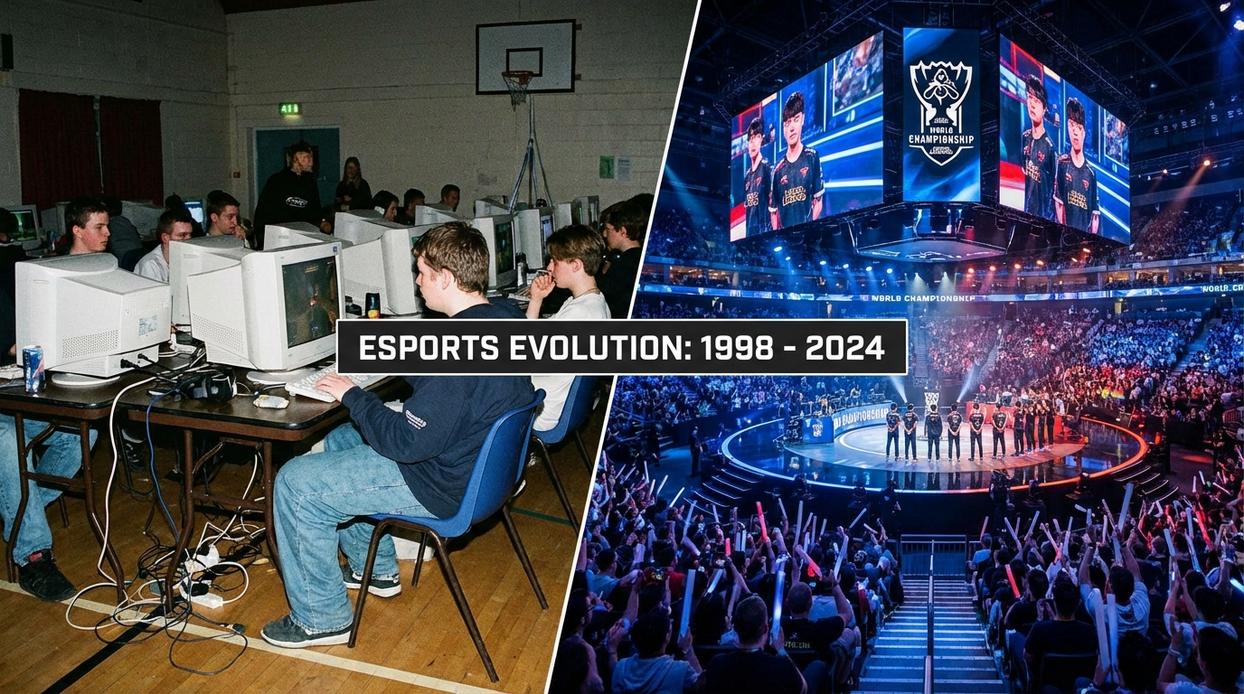
As broadband crept into homes and LAN cafes buzzed from Seoul to Southern California, competitive gaming stopped feeling underground and started looking organized. In 1997, the Cyberathlete Professional League (CPL) formalized what had been chaotic meetups. By standardizing brackets, rulesets, and prize pools that sometimes topped $100,000 (a staggering sum then), the CPL helped legitimize pro gaming in Dallas ballrooms and BYOC halls alike. Some critics argued it was still niche hobbyism with flashy checks. Yet structure, sponsorships, and media coverage marked a clear step in the evolution of esports tournaments.
Meanwhile, South Korea turned StarCraft: Brood War into prime-time drama. OnGameNet and MBCGame aired OSL and MSL matches in packed studios in Yongsan’s PC bang district. Corporate-backed teams like SK Telecom T1 housed salaried pro-gamers in team houses, complete with coaches and analysts (think baseball farm systems, but with APM counters). Detractors claimed the hype was regional. However, televised production value and celebrity status proved esports could anchor a national market.
Then, across the Pacific, Major League Gaming (MLG) launched in 2002, betting on Halo 2. Hosting circuits from New York to Las Vegas, MLG validated controller-based competition. Precision aiming, map control on Lockout, and coordinated “four-shot” callouts showed consoles weren’t casual toys.
Key shifts defined this era:
- RTS macro and micro management refined best-of series formats.
- FPS teamwork demanded map veto systems and structured scrims.
- Sponsorship models mirrored traditional sports economics.
Together, these forces transformed scattered tournaments into a global competitive circuit.
The Spectacle Era: MOBAs and the Streaming Revolution (2010s)
The 2010s didn’t just grow esports—they industrialized it.
1. The Prize Pool Game-Changer
In 2011, Valve launched Dota 2’s The International with a then-staggering $1.6 million prize pool. By 2013, Valve introduced the Compendium, a crowd-funded digital pass where 25% of sales boosted the prize pool. The result? Over $34 million in 2019 (Esports Earnings). This wasn’t pocket change—it was proof that fans would directly finance competition. Critics argued crowdfunding was unsustainable hype. Yet year-over-year growth demonstrated repeat buyer engagement and long-term viability.
2. Perfecting the Live Event
Riot Games elevated the League of Legends World Championship into a Super Bowl–level spectacle. The 2017 Finals in Beijing’s Bird’s Nest Stadium drew over 80,000 live attendees, with 99.6 million unique online viewers (Riot Games data). Elaborate AR dragons and K-pop collaborations blurred gaming and mainstream entertainment (yes, imagine the Oscars with pentakills). Some skeptics dismissed it as style over substance—but production quality legitimized esports in the eyes of sponsors like Mercedes-Benz and Mastercard.
3. The Viewership Boom
Twitch, acquired by Amazon for $970 million in 2014 (Amazon press release), became the backbone of accessibility. By 2018, it averaged over 15 million daily active users. Streaming created direct monetization through ads, subscriptions, and donations—clear evidence of sustainable creator income and a blueprint for what it takes to become a professional esports player.
4. The In-Game Economy
CS:GO Majors tied cosmetic sticker sales to prize pools, generating millions per event. Valve reported over $70 million raised via in-game purchases by 2019. The evolution of esports tournaments wasn’t accidental—it was engineered through data-driven monetization and measurable fan investment.
The Modern Landscape: Franchising and New Frontiers
The Franchise Model has reshaped competitive gaming, with city-based leagues like OWL and LCS aiming for stability and regional loyalty (think traditional sports playbooks, but with more RGB lighting). Critics argue franchising limits grassroots access, and they may have a point; buy-ins are steep, and long-term profitability remains debated.
- Mobile esports is surging, especially across Asia and emerging markets, where PUBG Mobile and Honor of Kings draw massive crowds and redefine the evolution of esports tournaments.
As for VR/AR and mainstream media integration, the upside is exciting—but honestly, sustainable adoption is still uncertain.
More Than a Game: The Enduring Legacy of Competition
From a handful of students huddled around a single computer to sold-out arenas and millions streaming worldwide, competitive gaming has transformed into a global phenomenon. This explosive rise was powered by rapid technological innovation—high-speed internet, live streaming platforms—alongside deeper, more strategic game design and a passionate, digitally native community. The evolution of esports tournaments reflects four decades of creativity, connection, and relentless competition. If you wanted to understand how gaming became a cultural powerhouse, you now have the full picture. Competitive gaming isn’t a passing phase—it’s a permanent, influential force shaping modern entertainment and community.
 Founder & Chief Visionary Officer
Neylora Vassorin has opinions about gamer gear optimization tips. Informed ones, backed by real experience — but opinions nonetheless, and they doesn't try to disguise them as neutral observation. They thinks a lot of what gets written about Gamer Gear Optimization Tips, Esports and Player Perspectives, Geek-Level Gaming Strategies is either too cautious to be useful or too confident to be credible, and they's work tends to sit deliberately in the space between those two failure modes.
Reading Neylora's pieces, you get the sense of someone who has thought about this stuff seriously and arrived at actual conclusions — not just collected a range of perspectives and declined to pick one. That can be uncomfortable when they lands on something you disagree with. It's also why the writing is worth engaging with. Neylora isn't interested in telling people what they want to hear. They is interested in telling them what they actually thinks, with enough reasoning behind it that you can push back if you want to. That kind of intellectual honesty is rarer than it should be.
What Neylora is best at is the moment when a familiar topic reveals something unexpected — when the conventional wisdom turns out to be slightly off, or when a small shift in framing changes everything. They finds those moments consistently, which is why they's work tends to generate real discussion rather than just passive agreement.
Founder & Chief Visionary Officer
Neylora Vassorin has opinions about gamer gear optimization tips. Informed ones, backed by real experience — but opinions nonetheless, and they doesn't try to disguise them as neutral observation. They thinks a lot of what gets written about Gamer Gear Optimization Tips, Esports and Player Perspectives, Geek-Level Gaming Strategies is either too cautious to be useful or too confident to be credible, and they's work tends to sit deliberately in the space between those two failure modes.
Reading Neylora's pieces, you get the sense of someone who has thought about this stuff seriously and arrived at actual conclusions — not just collected a range of perspectives and declined to pick one. That can be uncomfortable when they lands on something you disagree with. It's also why the writing is worth engaging with. Neylora isn't interested in telling people what they want to hear. They is interested in telling them what they actually thinks, with enough reasoning behind it that you can push back if you want to. That kind of intellectual honesty is rarer than it should be.
What Neylora is best at is the moment when a familiar topic reveals something unexpected — when the conventional wisdom turns out to be slightly off, or when a small shift in framing changes everything. They finds those moments consistently, which is why they's work tends to generate real discussion rather than just passive agreement.